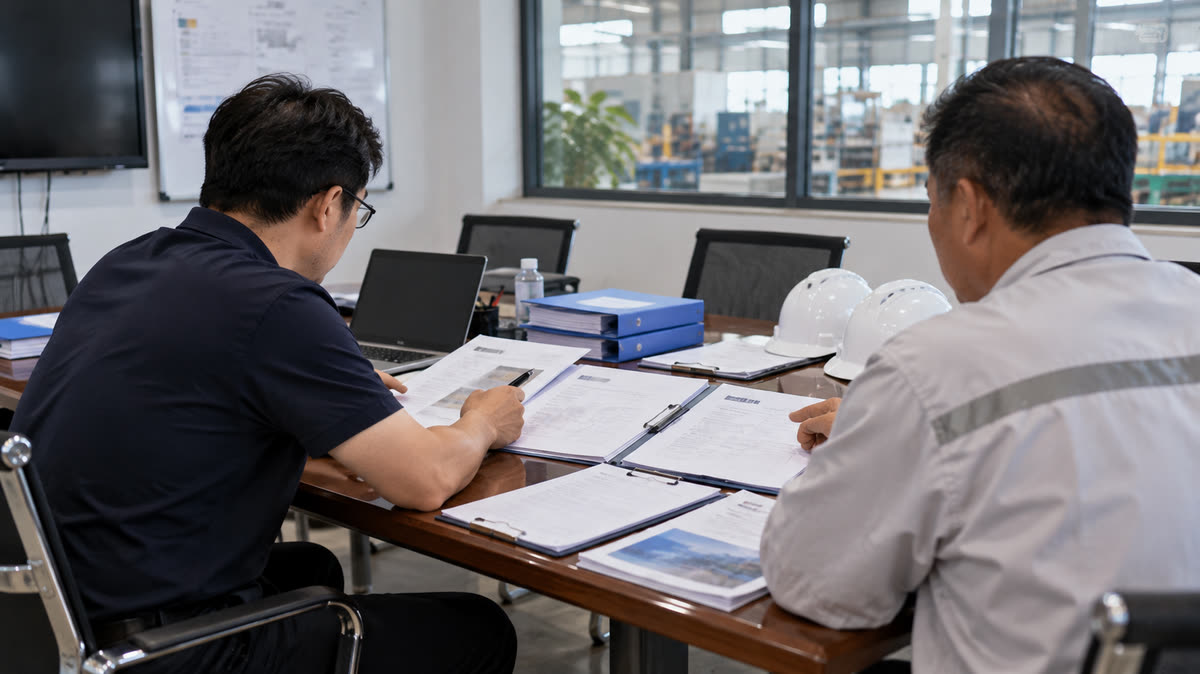
Supplier verification: clean registration, normal pricing, but the site did not match
Typical service scenario, not a specific client case. Shows the risk of judging a supplier on registration and a quotation alone, and which items an on-site verification must cover.
| Content type | Typical service scenario — not a specific client case |
|---|---|
| Project region | Philippines |
This page describes a typical engagement pattern. It is not evidence that a specific project was completed, and contains no client-confidential data.
Background
A client planned to buy industrial components from an online supplier quoting 15% below peers, with complete registration documents, factory photos and a 60% prepayment demand.
Challenges
- Registration documents were genuine, with the category in scope;
- The price was well below market, explained as “own factory, no middlemen”;
- The client was ready to pay, with no local means of verification.
What we did
- Document layer: active registration, shareholder structure and business scope all clean;
- Site visit: the registered address was a co-working space; actual production claimed elsewhere;
- At the claimed factory: roughly 200 sqm of office and storage, two machines, both idle;
- Cross-checked with neighbouring businesses: no steady production activity recently;
- Bank check: the receiving account was a personal account, not matching the company name.
Results
- The client cancelled, avoiding about USD 380,000 of prepayment risk;
- We delivered four verifiable alternative suppliers within two weeks;
- The client added supplier verification to its standard procurement process.
Conclusion
Genuine documents do not prove capability. The mismatched receiving account was the clearest red flag.
Related
How to verify a Philippine company’s registration and operating reality
A registration certificate proves existence, not capability. Verification works in three layers: documents, site, third parties.
Building materials entry: from scattered orders to a stable channel
Typical service scenario, not a specific client case. Shows how channel rebuilding and access gap closure usually run for a Chinese building-materials manufacturer entering the Philippines, and where it stalls.
Food processing plant: the critical path from site selection to commissioning
Typical service scenario, not a specific client case. Shows how siting, permitting and equipment arrival interlock for a food plant, and where the process most often stalls.